How Pirosmani was discovered
A tavern by the station, futurists from St Petersburg and an exhibition in Moscow: 1912-1913.
1912
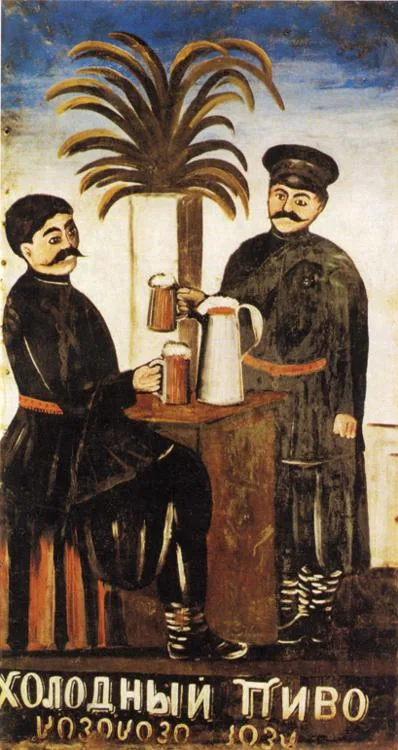
Until 1912 Niko Pirosmani had no ties at all with the art world of Tiflis. He painted signboards and panels for taverns, shops and traders, took small money for it and lived in poverty. His customers saw decoration for a business, not art. A word about the material: the familiar story that he painted on oilcloths taken off the tavern tables comes from Paustovsky and is wrong. He bought the oilcloth, black, matt and industrial, and left it unpainted wherever he wanted it to show.
In 1912 Kirill Zdanevich, a Tiflis man studying painting in St Petersburg, brought his friend the painter Mikhail Le Dentu home with him. They walked the old town and stepped into the tavern Varyag near the railway station. On the walls hung paintings that looked nothing like ordinary tavern work. At first they did not know who had made them. Le Dentu bought one of them, by the recollections a Feast of Mice, oil on oilcloth, and from there began a round of tavern after tavern: more and more paintings turned up. The exact date is disputed: reference works say the summer of 1912, scholars of Le Dentu place the find at the end of March.
That is how they reached Niko Pirosmanashvili himself. Kirill began buying works from him and commissioning new ones, and gradually built a collection. But the main thing the Zdanevichs and Le Dentu did was not collecting; it was a change of optics. What the townspeople took for signboard trade, they saw beside the European avant-garde they belonged to themselves.
The younger brother, Ilia, was by then inside the futurist circle of Mikhail Larionov and Natalia Goncharova and knew how to make noise. On the tenth of February 1913 he printed in the Tiflis paper Zakavkazskaya Rech the article «A Self-Taught Artist», one of the first publications on Pirosmani. On the twenty-fourth of March of the same year the futurist exhibition Target opened in Moscow on Bolshaya Dmitrovka, and there, beside Larionov and Goncharova, hung the paintings Ilia had brought from Tiflis; among them are named A Woman with a Beer Mug, A Deer, a still life and a portrait of Ilia Zdanevich himself.
After that the interest widened: E. Pskovitinov wrote about Pirosmani in the paper Zakavkazye, the young painters David Kakabadze and Lado Gudiashvili took up his work, and Dimitri Shevardnadze began to gather a collection. On the fifth of May 1916 a one-day exhibition of Pirosmani's work was held in Kirill Zdanevich's studio, and the artist was invited into the newly founded Society of Georgian Artists. It changed his life very little: the prohibition of 1914 had taken away his orders for tavern signboards, and on the seventh of April 1918 he died in Tiflis of hunger and illness. Where he is buried is unknown.
The story has a long tail. In 1972 Ilia Zdanevich, long since the Parisian Iliazd, published the book Pirosmanashvili 1914; the portrait of the artist for it was etched by Pablo Picasso, who signed the edition in December, four months before his own death. From a tavern wall by the Tiflis station to the hand of Picasso took sixty years.