The summer of 2008: the run-up and the five days of August
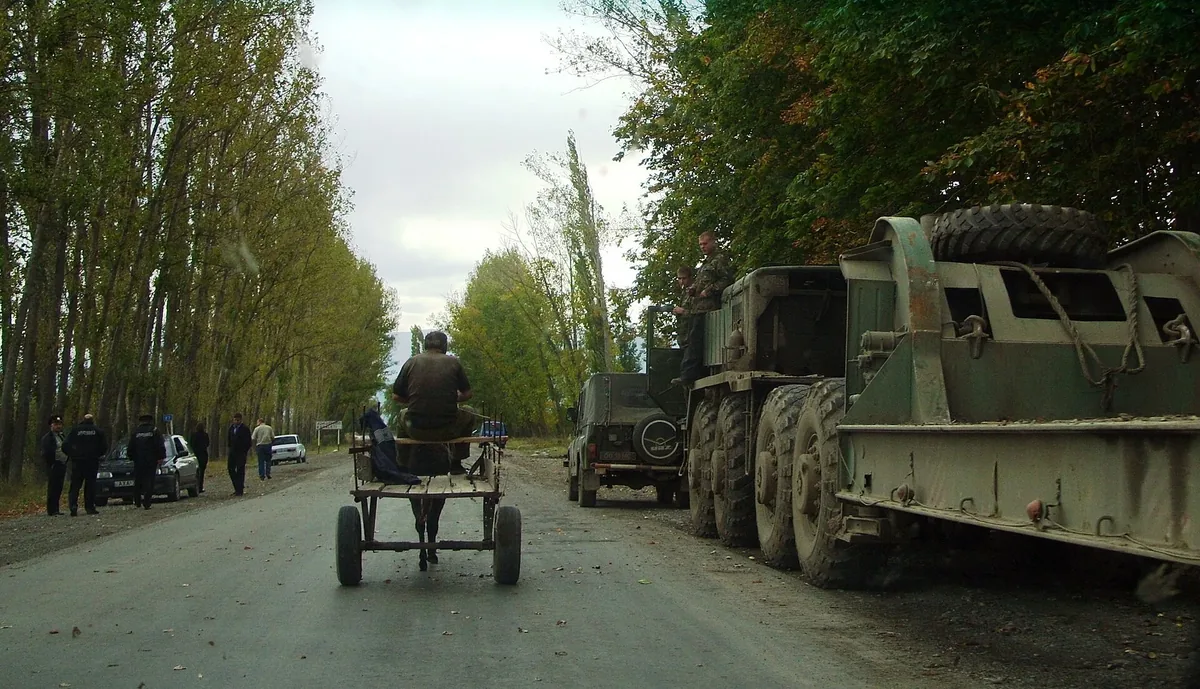
The argument over who started the war turns on where you begin counting. Start from the night of 8 August and the Georgian assault on Tskhinvali comes first. Step back to the spring and the picture changes: by August both sides had spent months doing what states do before a war. The dates below are checked against reports written as events unfolded, not against later explanations.
The count can begin earlier still, with somebody else's independence. On 17 February 2008 Kosovo separated from Serbia and the West recognised it, calling the case unique. Three days before that, on 14 February, Vladimir Putin used his last presidential press conference to answer plainly: «We have Abkhazia, South Ossetia, Transnistria, and they exist as independent states. We are told all the time that Kosovo is a special case. That is all lies, there is nothing special about it, and everyone understands that perfectly well.» In the same answer he said Moscow would not copy others move for move: «We are not going to ape anyone... We have our own preparations at home, and we know what we are going to do.» What followed was the carrying out of those words.
On 3 and 4 April the NATO summit in Bucharest refused Georgia a Membership Action Plan, while writing into its declaration that the country would one day join the alliance. On 16 April Vladimir Putin instructed his government to establish direct relations with Abkhazia and South Ossetia: recognition of documents, links between agencies, foreign ministry offices in Sukhumi and Tskhinvali. Formally this was not recognition of independence; in practice it bypassed Georgian jurisdiction, and Tbilisi called it creeping annexation.
On 20 April a Georgian drone was shot down over Abkhazia. The UN mission established that the aircraft that fired was not part of the peacekeeping force, but the same report also recorded a Georgian violation: reconnaissance flights over the conflict zone were banned by the 1994 agreement. That double finding is the hard part of this subject. In almost every episode both sides turn out to be in breach, and the question is only of degree.
On 31 May Russian railway troops entered Abkhazia, some three hundred men, officially to repair the tracks. From 15 July to 2 August the North Caucasus Military District held the Kavkaz-2008 exercise: about eight thousand men, the 58th Army and the Black Sea Fleet, and among the stated tasks was support for Russian peacekeepers in Abkhazia and South Ossetia.
August opened with an explosion. On the first, a vehicle carrying Georgian police was blown up on the Eredvi and Kheiti bypass road; five were wounded, one severely. Shooting began that evening and never really stopped: Avnevi, Nuli, Ergneti and both Nikozi villages came under fire.
On 7 August the state minister for reintegration, Temuri Yakobashvili, travelled to Tskhinvali, but no talks took place: the chief negotiator, Boris Chochiev, could not be reached. At 19:10 Mikheil Saakashvili announced a unilateral ceasefire on television. Around 20:30 the shelling resumed, and at 23:35 the president ordered the army to halt the movement of Russian units through the Roki tunnel and to suppress the firing positions.
On 8 August at 02:37 Moscow informed Tbilisi that it was beginning a military operation; by 05:20 the columns had passed Java. Around 11:00 Georgian units entered Tskhinvali and by 20:30 had left the centre. From the morning Russian aircraft struck the Gori and Kareli districts, in the afternoon Marneuli, Bolnisi and the Vaziani base near Tbilisi, and at night Poti. On its first day the war reached far beyond the disputed region. Dmitry Medvedev called what was happening the enforcement of peace.
Alongside the fighting in the south, a front opened in the mountains. On 9 August Abkhaz forces, supported by Russian ones, began an operation in the Kodori Gorge, the only part of Abkhazia still held by Tbilisi. Three days later the Georgian units left, and on 12 August Upper Kodori passed to Sukhumi and Moscow. According to the Georgian authorities, between 1,800 and 2,500 Svans who lived in the gorge left their homes. That was the end of the last Georgian-held territory inside Abkhazia.
The front then swung west. On 11 August Zugdidi and Senaki were taken and the navy blockaded the coast, keeping ships out of Poti. On the twelfth an Iskander missile hit the central square of Gori and killed eight people. The same day Medvedev announced the end of the operation, Nicolas Sarkozy brought a six-point plan from Moscow, the leaders of Poland, Lithuania, Estonia, Latvia and Ukraine flew into Tbilisi, and a rally filled the square.
The agreement was not signed at once: Saakashvili on 15 August, Medvedev on the sixteenth. The troops kept moving meanwhile. On the fifteenth a checkpoint appeared at the village of Igoeti, thirty kilometres from Tbilisi; on the sixteenth tanks entered Akhalgori. Human Rights Watch documented the use of cluster munitions in populated areas and looting in Georgian villages, while Eduard Kokoity and Znaur Gassiev said plainly that Georgian houses had been burned and their owners would not be allowed back.
The numbers of this war have to be given with the name of whoever counted them, and watched as they change. On 9 August, the second day of fighting, the Russian ambassador to Georgia declared that at least two thousand civilians had died in Tskhinvali and that the town no longer existed. It was this figure that went round the world's agencies and served as justification. Eleven days later Russian investigators spoke of 133 identified dead, and Human Rights Watch, working on the ground straight after the fighting, put the civilian death toll at fewer than a hundred. A twentyfold gap between a wartime claim and the same side's own count two weeks later is itself part of this war's history.
The losses each side reported about itself. On 15 September 2008 the Georgian government named 372 dead: 168 servicemen, 188 civilians and 16 police officers, with dozens more missing. The Russian defence ministry acknowledged 64 servicemen killed and 283 wounded. Only like may be compared with like: 168 against 64. According to the UN refugee agency, by 15 August about 115 thousand people had left their homes, Ossetians and Georgians alike.
On 26 August Russia recognised the independence of Abkhazia and South Ossetia. Almost no one followed, and the lines where the troops had stopped in August became the boundaries of the occupied territories.
After the war the line did not freeze. From the spring of 2013 fences began to go up along the administrative boundary of the Tskhinvali region, and they moved deeper into territory held by Tbilisi: at the village of Atotsi in late February 2014 the fence was shifted another 400 metres. According to the Georgian government, the artificial barriers along the occupation line in the Tskhinvali region add up to about 51 kilometres. In the summer of 2015, at the village of Tsitelubani, boundary markers were placed so that a section of the Baku-Supsa oil pipeline ended up on the occupied side. This is what creeping occupation means: the border is not drawn once and for all, it eats up kitchen gardens, cemeteries and roads year after year.
People are detained along this line all the time. The count runs to dozens a year on each section: by the end of 2022, for example, the European Union monitoring mission knew of 45 people detained along the Abkhaz line and 58 along the Tskhinvali one. A detention usually lasts two or three days and ends with a fine imposed by a «court» of the unrecognised authorities, but not always. In February 2018 Archil Tatunashvili was detained near the line; he died in Tskhinvali, forensic examination counted more than a hundred marks of torture on his body, and the body was returned without its internal organs. No verifiable source gives a cumulative total of detentions for all the years, and to state a round figure would be invention.
From here a straight line runs to what came next. In five August days Russia tested what the world would do: the answer was a six-point plan, European Union monitors along the line, and a return to business as usual within a year. No sanctions, no isolation, no price. Six years later the same method was repeated in Crimea, with the same elements: passports, protection of compatriots, soldiers without insignia and a referendum held under their guard. August 2008 was not a local conflict in the Caucasus but the first rehearsal that worked.