Racha-Lechkhumi and Kvemo Svaneti
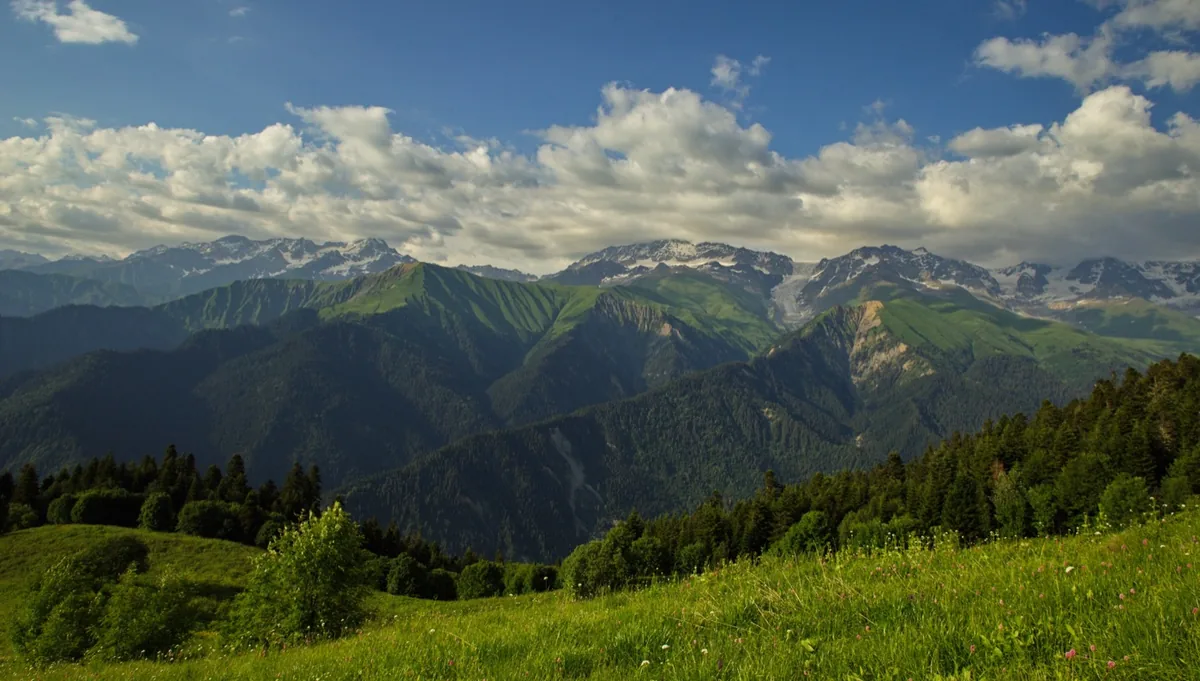
A mountainous north-west; the famed wines Khvanchkara and Tvishi, and Racha ham.
Racha-Lechkhumi and Kvemo Svaneti is Georgia's least populated and one of its most mountainous regions: three historical provinces (Racha, Lechkhumi and Kvemo Svaneti, or Lower Svaneti) are wedged between the Greater Caucasus range and the Racha-Lechkhumi ridge, in the upper reaches of the Rioni river.
Cultures meet here: lowland Racha with the vineyards of Khvanchkara and Tvishi, forested Lechkhumi with its fortresses and waterfalls, and mountainous Kvemo Svaneti with its own Svan towers, the lesser-known sibling of the more famous Zemo (Upper) Svaneti (Mestia, Ushguli), which belongs to the neighbouring Samegrelo-Zemo Svaneti region.
The region emptied out significantly during Soviet and post-Soviet times, many mountain villages stand abandoned, and the Racha ridge and the highlands around Oni and Lentekhi remain among the country's most remote and untouched corners.
Georgian ethnography does not single out a distinct, widely documented «Racha costume» as clearly as it does the Svan or Khevsur one, but it had recognisable features. Racha women wore a chokha over an akhalukhi undershirt, mostly in black satin, a detail that struck 19th-century foreign travellers.
In 1874 an English traveller noted that Racha women «wore short dresses and trousers… with grace», and the German scientist W. B. Pfaff was struck by the variety of Racha women's dress, comparing it to Anatolia's. Far less has come down to us about the region's male costume.
What to see
- Lake ShaoriThe largest body of water in Lower Racha: about seven kilometres long and nearly three wide. The lake is man-made, filled after a dam closed a mountain stream, and since then it has lain in a ring of coniferous and mixed forest above a thousand metres. The place is quiet, with no promenades or cafes: people come for the water, the forest and the view of the Racha range.
- Nikortsminda CathedralThe cathedral was built in 1010–1014 under King Bagrat III and is covered outside with stone carving unmatched anywhere else in Georgia: crosses, lions, griffins, saints and vine scrolls wind around the drum of the dome and over every facade. Inside, seventeenth-century murals survive, laid over earlier ones. The plan is rare for its time, with six apses around the space beneath the dome. Nikortsminda is on the tentative list of UNESCO World Heritage.
- AmbrolauriThe administrative centre of Racha-Lechkhumi and Kvemo Svaneti. The town stands where the Krikhula flows into the Rioni, in the middle of the Khvanchkara zone, and in the seventeenth century it served as a residence of the kings of Imereti. Just before the mouth the town brook Krikhmela joins the Krikhula, now half hidden in pipes and channels. On the main square stands a monument to a bottle of Khvanchkara, and the sign is honest: around it lie the very slopes where Aleksandrouli and Mujuretuli grow, and the wine comes out like this nowhere else. The town has a museum of fine art; Nikortsminda is twenty minutes away, Oni an hour.
- BarakoniThe church in the village of Tsesi was built in 1753 by the master Avtandil Shulavreli for Rostom, eristavi of Racha. It stands on the cliff at the meeting of the Rioni and the Lukhuni, and it is one of the last Georgian churches raised in the old manner: a high drum, fine proportion, carving over the facades. After it came a long pause in Georgian church building, so Barakoni closes a tradition begun eight centuries earlier.
- Minda FortressThe fortress stands opposite Barakoni, across the road, and is one of the few surviving castles of the province. The site follows the same logic as the church: a rocky spur above the meeting of the rivers, from which the whole road up the gorge is in view. Racha lived for centuries at a crossing of routes between Imereti, Lechkhumi and the mountains, and small strongholds like this held the passes until they were left as no longer needed.
- Skhvava: Kvaratsikhe and the church of St GeorgeA village above the right bank of the Krikhula, remembered for two sets of ruins. The fortress of Kvaratsikhe was raised on a high rock in the eleventh century; in the late Middle Ages it belonged to the crown; in the sixteenth century it was taken by Simon I, king of Kartli; early in the eighteenth it passed to the Iashvili family; from 1769 it was royal again, and in 1810, when the kingdom of Imereti was annexed to Russia, the garrison surrendered it to the Russian army. The earthquake of 29 April 1991, the strongest ever recorded in the Caucasus, brought down hundreds of buildings in Racha: almost nothing of Kvaratsikhe survives today, and of the church of St George only the walls are left, now overgrown; the photograph by Levan Davlianidze shows the masonry and a surviving opening. Here too the Krikhula comes out from under the rock: the river is spring-fed, and at Shua Skhvava the glacial stream Kvaratskali joins it out of a wooded gorge. Kvaratsikhe stands in that same gorge and shares the stream's name. The water of the Krikhula now supplies Ambrolauri, which lies downstream where it meets the Rioni.
- The Skhvava ice caveA karst cave above the village of Shua Skhvava, at one thousand three hundred and ten metres. The name translates as ice house, and it is exact: the temperature inside stays below zero all year round, so at the height of summer there are pillars and flows of ice. Local people took ice from here for centuries, medicine among the uses, and the cave remains a natural cold store rare for Georgia.
- OniA small town on the Rioni, the centre of Upper Racha and one of the oldest settlements of the province. It grew where the mountain road opens into the wide part of the valley, and lived for centuries by trade and craft. Georgians, Jews and Armenians settled here: the streets near the centre still remember that neighbourhood, and the synagogue stands a few steps from the church. Roads to Shovi, to Utsera and on to the passes of the Caucasus range start here.
- The synagogue of OniThe synagogue was built in 1895, and its design closely follows the outline of the one in Warsaw. The Jewish community of Oni was the third in the country after those of Tbilisi and Kutaisi, and the building is counted among the finest synagogues in Georgia. Almost nothing is left of the mountain community: people went to Israel and to the cities, but the building was restored in 2014 and listed as cultural heritage. For Racha it is as much a landmark as Nikortsminda or the Khvanchkara bottle.
- UtseraA spa resort in Upper Racha, ten kilometres from Oni up the Rioni. Mineral waters of some twenty-eight types come to the surface here; they are drunk and used for baths. The place has been known since Soviet times, when people came from all over the country for treatment, and it has lived more modestly since: a few buildings, springs by the road, the air of the pine forest. Shovi is a little over twenty kilometres further on.
- ShoviA mountain resort in the upper Rioni valley at fifteen hundred and twenty metres, among pines and glacial ridges. Local people had long known the healing springs; a society for building a sanatorium appeared here early in the twentieth century, and Shovi took shape as a resort in 1929, with more than a dozen carbonated mineral springs around it. On 3 August 2023 a mudflow from the glacier swept over the resort and took thirty-three lives; afterwards the state environmental agency forbade rebuilding here.
- Sairme PillarsA natural monument above the Tsablaristskali valley, between the villages of Alpana and Tchrebalo. The free-standing towers, several dozen metres high, are what remained after water and wind worked at Palaeogene rock for tens of millions of years; pines hold on at their tops. A path of about three kilometres, waymarked in 2021, leads to the pillars, and the walk there and back takes some two hours. On the way stand the ruins of a church of St George whose age is still unknown. The place is far less known than the Katskhi pillar, though it is no less striking. Photograph by Levan Davlianidze, July 2025.
- LailashiA village eighteen kilometres east of Tsageri, at about eight hundred and fifty metres above the Lajanuri reservoir. A Jewish community lived here for centuries: the stone synagogue was raised in the middle of the village in 1860, and it gathered some sixty people on weekdays and up to a hundred and twenty on holidays. In the 1940s the parchment Lailashi Bible of the tenth century was found in this synagogue: a codex, a book rather than a scroll, which is rare for its age; since 1957 it has been kept in the National Centre of Manuscripts of Georgia. The community is long gone, and the village is remembered for the synagogue and for the spring with a pool that looks out over the whole valley. Photograph by Levan Davlianidze.
- TsageriThe centre of Lechkhumi, a small town on the Tskhenistskali under wooded slopes. Roads run from here to the places people come to Lechkhumi for: east to Lailashi with its synagogue, south to the Sairme pillars and Khvamli, up the river to Muris-tsikhe. Around it lies the zone of two rare wines, Tvishi and Usakhelouri, and the villages of Lechkhumi still make them in small lots, as they always did.
- Muristsikhe (Muri Fortress)A medieval fortress above the Tskhenistskali, called impregnable in the sources: its walls sit on a rock ridge, and a single narrow path leads up to them. From here the eristavis held Lechkhumi, and the castle remained the political centre of the province until the 19th century, when administration moved down into the valley. Today towers and stretches of wall remain, reached by a climb from the road, and the view over the gorge that is the real reason to come up.
- OkureshiA village in Lechkhumi that gave its name to the rarest Georgian grape: Usakhelouri is also called Okureshuli, after this place. The vine grows in only a few villages around, Okureshi with Zubi, Opitara, Isunderi and Lachepita, and the harvest everywhere is counted not in tonnes but in hundreds of kilogrammes. The wine comes out naturally semi-sweet, dark and fragrant, and costs more than almost any other in Georgia. The village name is fixed in the appellation Okureshis Usakhelouri.
- Mount KhvamliA limestone massif two thousand and two metres high with sheer walls and a karst interior: about twenty caves have been surveyed, the best known of them the deep shaft of Tekenteri. It is to Khvamli that Georgian tradition chains Amirani, the hero who gave people fire and crafts and was punished for it, the local kinsman of Prometheus; Jules Verne, in one of his novels, places Prometheus himself on this rock. Medieval chronicles say that in the Mongol period the royal treasury was hidden in the mountain. The same tradition adds that the cave holding Amirani opens once every seven years, and then the hero can be seen. And once a year, on the eighth Saturday after Easter, the villages below climb up for the feast of Khvamloba: a service at dawn, then a table on the plateau.
- The Svan towers of LeksuriThe stone towers of Leksuri belong to the heritage of Kvemo Svaneti, Lower Svaneti: the same building tradition as the famous towers of Mestia and Ushguli on the other side of the pass, only fewer here and seldom visited. A tower was raised beside the house as the family's last refuge: the lower floors are blind, the entrance is lifted above the ground, and at the top are loopholes and a platform from which the neighbouring villages and the gorge beyond are in sight. Many have stood since the 12th to 14th centuries.