Jewish Racha
Oni, Lailashi and the Jewish communities of mountain Racha: synagogues, the Lailashi Codex and the emptied quarters.
1895
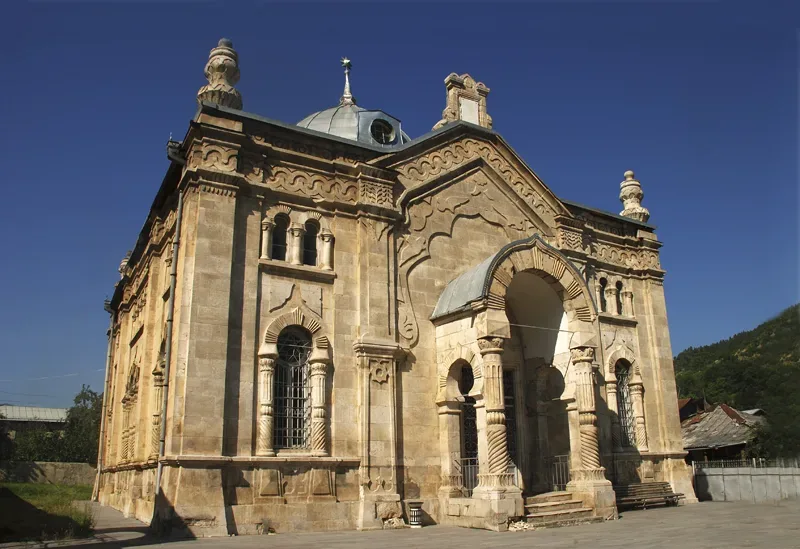
Mountain Racha is not only wine country. Jewish communities lived for centuries in Oni, Lailashi and Tsageri: Jews have been in Georgia for more than two and a half thousand years, and these mountain towns were as much their home as that of their Georgian and Armenian neighbours. The community of Oni was reckoned the third in the country after Tbilisi and Kutaisi, and its synagogue stands a few steps from the church.
The Oni synagogue was built in 1895 in an eclectic Moorish revival style; it is the oldest working synagogue in Georgia and the third largest. The earthquake of 1991 damaged the building, which was restored with support from the state and the Joint Distribution Committee, and in 2015 the community marked its hundred and twentieth anniversary. In Lailashi, already in Lechkhumi, a stone synagogue had stood since 1860: about sixty people gathered there on ordinary days and up to a hundred and twenty on feasts.
From the Lailashi synagogue comes the Lailashi Codex, a Masoretic Pentateuch of the tenth or eleventh century, written in three columns and decorated with micrography. It is a book rather than a scroll, which is rare for its age. The main part of the manuscript is kept at the National Centre of Manuscripts in Tbilisi; three leaves turned up at the National Library of Israel.
Almost nothing of the communities remains. In 1972 three thousand one hundred and fifty people prayed in the Oni synagogue; in 2015 there were sixteen. They left for Israel in two waves, in the 1970s and in the 1990s. The sources describe no separate Jewish school of winemaking in Racha, and it would be wrong to invent one: the community lived within the common Rachan way of life, where wine is made in every house, while its usual trades were commerce and craft.