The Ganja (Derbent) gate and the tomb of David IV at Gelati
At the southern gate of Gelati lies David IV the Builder — set so that those entering step on his slab; opposite, a leaf of an iron gate is built into the wall, its origin disputed between a Ganja and a Derbent version.
1139
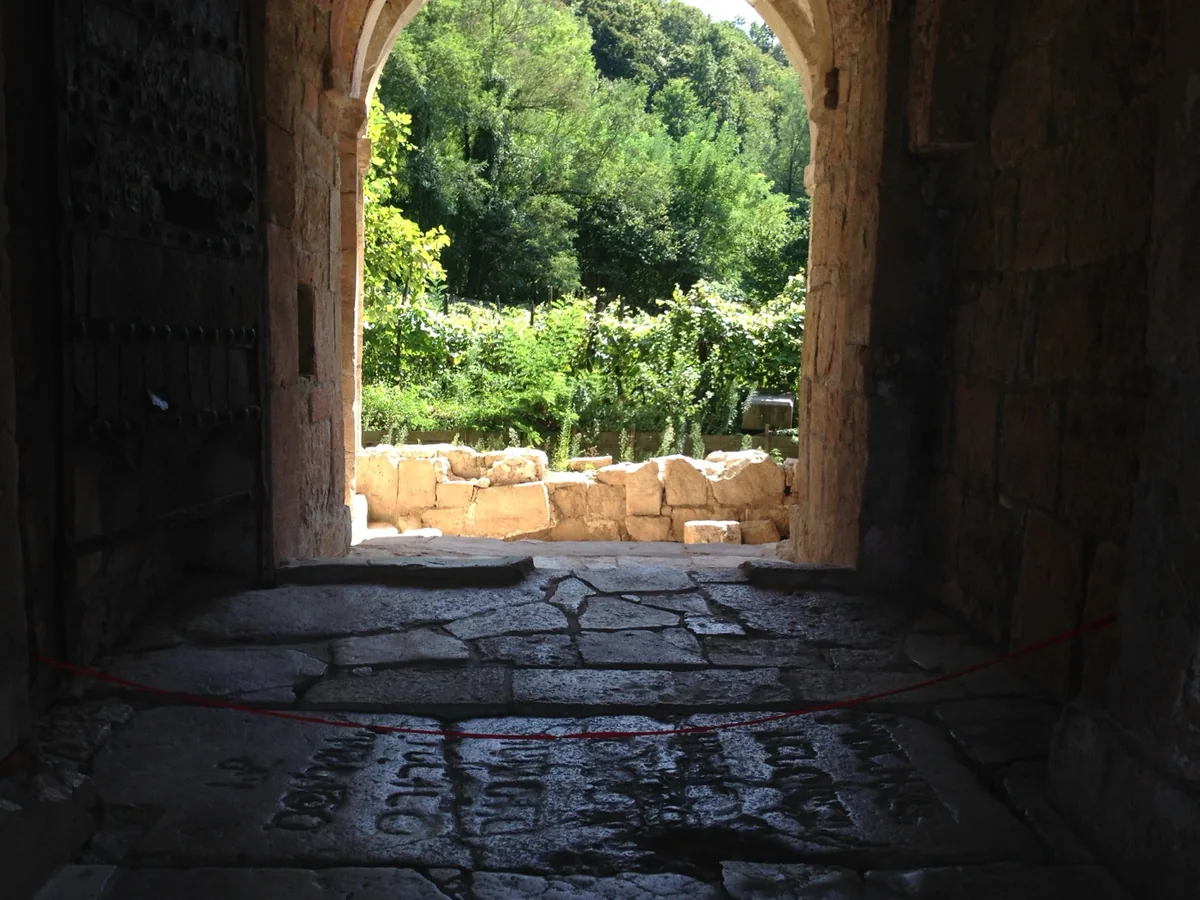
David IV the Builder (died 1125) is buried at the Gelati monastery, which he himself founded. By his own will he was laid not inside the church but at the southern gate — so that everyone entering would step on his tombstone; this is read as a sign of the great king's humility.
On the slab is an inscription in the ancient capital script (Asomtavruli); by tradition it is the psalm verse David himself chose: «This is my rest for ever and ever; this I desired, here shall I dwell» (Ps. 131:14). The stone is worn smooth by the feet of those entering.
Opposite the grave, a leaf of a wrought-iron gate is set into the wall — a famous trophy. Two versions dispute its origin.
The first, the Ganja version (supported by the Arabic inscription on the gate itself): the gate was forged in 1063 by the smith Ibrahim ibn Osman for the Shaddadid emir of Ganja; in 1139, after an earthquake had devastated Ganja, David's son King Demetre I carried it off as a trophy.
The second, the Derbent version: popular tradition ascribes the gate to David the Builder himself, said to have brought it from Derbent (Darubandi), then under Georgian influence. This is contested: the inscription names Ganja, not Derbent, and David died years before the gate was taken. The debate between the Ganja and Derbent attributions is not settled.
Yet the two versions are less far apart than they seem. The gate was forged in 1063 for the Ganja emir Shavur ibn Fadl (Abu'l-Aswar) of the Kurdish Shaddadid dynasty, and his son Fadl II soon captured Derbent; by 1075 a Seljuk governor held Ganja and Derbent together. For a time the two cities were under one house — which is why the Ganja and Derbent attributions were so easily confused. The very word «Darband» means «the barred gate» — the name of Derbent itself — while David the Builder was famed as the overlord of Derbent; all this fed the tradition.