Tbilisi
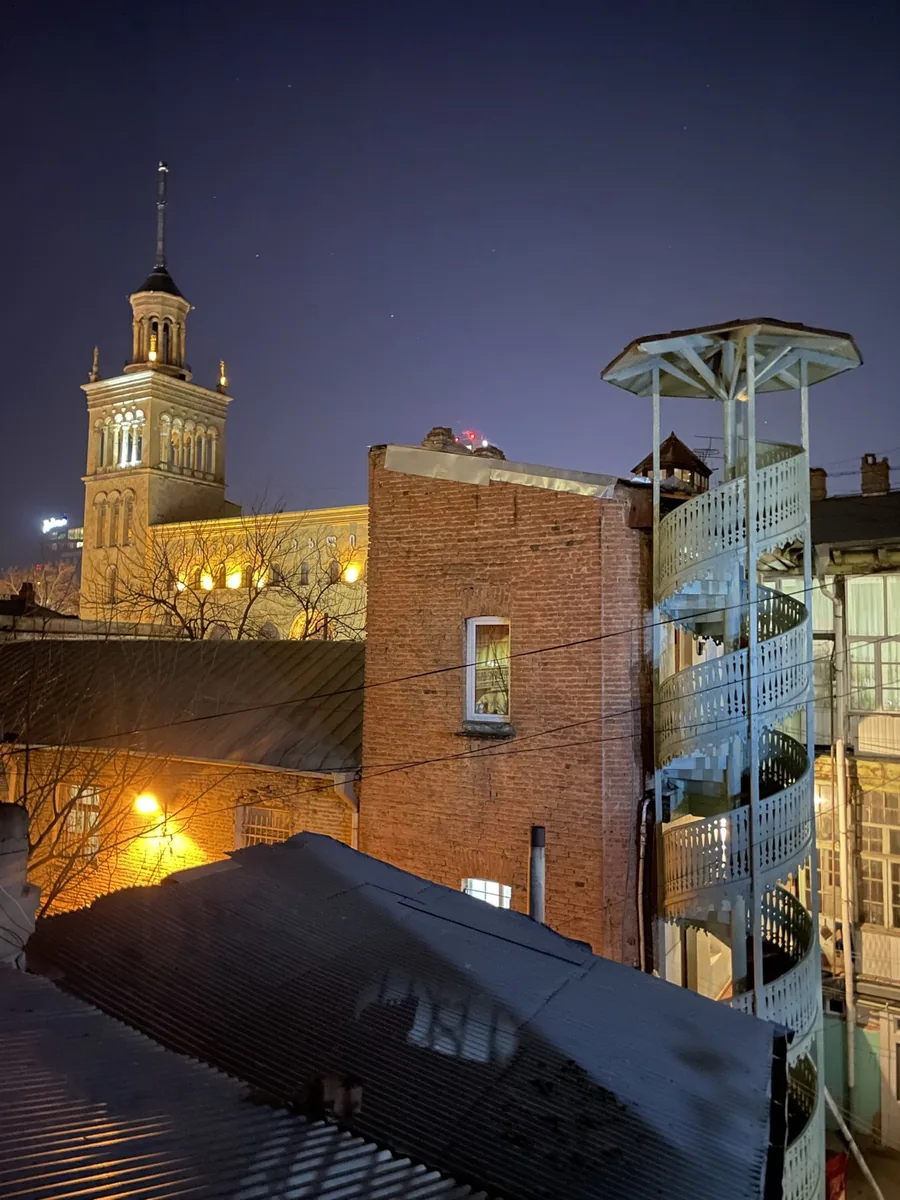
The nation's capital and a separate administrative unit, founded in the 5th century. Narikala, the old town, the sulphur baths.
Tbilisi is Georgia's capital and a separate administrative unit, straddling both banks of the Mtkvari (Kura) river at the foot of the Trialeti range. According to legend, King Vakhtang Gorgasali founded the city in the 5th century on the site of sulphur springs discovered during a falconry hunt; his successor Dachi moved the capital here from Mtskheta before the century was out.
Its position on the Silk Road meant the city changed hands repeatedly over a millennium and a half: Persians, Arabs, Byzantines, Seljuks (liberated by David the Builder after the 1121 Battle of Didgori), Mongols, Persians again, Ottomans, and from 1801 the Russian Empire.
Tbilisi has long been multiethnic: 17th-century travellers noted Armenians, Greeks, Jews, Persians and Tatars alongside Georgians. The city's name comes from the Georgian «tbili», «warm», after the sulphur springs of Abanotubani.
Tbilisi's distinctive urban dress was not regional but social: the black chokha was worn by the karachokheli, the craftsmen and traders of the 19th-century old town known for their love of wine, song and lavish feasts; their image survives today in the «Karachokheli» dance.
Alongside the karachokheli, the costume of Tbilisi's kintos (street peddlers), with its distinctive black cap, became another recognisable urban type of pre-revolutionary Tbilisi, captured in the paintings of Niko Pirosmani.
What to see
- AbanotubaniThe quarter of sulphur baths at the foot of Narikala is where, by legend, Tbilisi began: King Vakhtang Gorgasali came upon the hot springs while hunting, and the city took its name from tbili, warm. The domed baths of the 17th to 19th centuries are sunk into the ground, so only their brick cupolas with light holes rise above it. The most ornate, the Orbeliani bath, hides behind a blue tiled facade in the Persian style. Pushkin visited in 1829 and wrote that he had never met anything more luxurious than the baths of Tiflis.
- The Juma MosqueThe only working mosque in Tbilisi stands in Abanotubani beside the sulphur baths. The first mosque here was built by the Ottomans in the 1720s; it was destroyed and rebuilt more than once, and the present building with its striped minaret dates from the end of the 19th century. Until 1951 the Blue Mosque stood nearby, where the Shia prayed, but it was pulled down for the building of a bridge. Since then Sunni and Shia have prayed here under one roof, a rarity in the Muslim world.
- The Botanical GardenThe garden lies in the Tsavkisistskali gorge directly below Narikala, on the site of the old royal gardens mentioned in sources as early as the 17th century; as a botanical garden it dates from 1845. Today it covers more than a hundred hectares along the stream, with Caucasian and East Asian collections, old plane trees and a brick bridge over the water. Deeper in the gorge there is a waterfall reached by a path, and from above the garden connects to the fortress.
- Narikala FortressThe fortress on the Sololaki ridge above Abanotubani already stood in the 4th century, when it was called Shuris-tsikhe, the envied fortress. Under the Arab emirate it became the city's main stronghold and acquired its present name, and David the Builder enlarged and strengthened it. The earthquake of 1827 brought down walls and towers, after which the fortress lost its military role for good. The church of St Nicholas inside was rebuilt in 1996 on its historic foundations. The terrace opens a panorama over Old Tbilisi and the bend of the Mtkvari.
- Kartlis Deda, the Mother of GeorgiaThe figure of a woman on the Sololaki ridge was raised in 1958 for the fifteen hundredth anniversary of the city, modelled by Elguja Amashukeli, the same sculptor who made the equestrian Vakhtang at Metekhi. At first she was wooden, later replaced in aluminium, and renewed again in the nineties. The meaning reads from far off: a bowl of wine in one hand for a friend, a sword in the other for an enemy. Twenty metres tall, visible from almost anywhere in the centre.
- The Narikala cable carThe line from Rike Park across the Mtkvari to Narikala has run since 2012, replacing the old Soviet cable car that was stopped after an accident in the eighties. The cabins pass over the river and the tiled roofs, the ride takes a few minutes, and the fare is the same city card as the metro and buses. At the top you step out beside the fortress walls and the Mother of Kartli, and you can walk back down through Abanotubani.
- The Rike Tubes, Fuksas concert hall and exhibition centreThe two fused tubes of glass and steel in Rike Park were built in 2011–2012 to a design by Massimiliano and Doriana Fuksas: a concert hall and an exhibition space were meant to go inside, and the tubes themselves were to anchor the new embankment. The building never opened: work stopped after the change of government, and since then the tubes have stood empty, the best-known monument to the decade's unfinished projects. From 2026 the city authorities plan to demolish them.
- Metekhi ChurchThe church of the Dormition stands on the cliff above the Mtkvari, where Vakhtang Gorgasali placed his residence and the first church; tradition holds that St Shushanik, the first Georgian martyr, is buried in Metekhi. The present building went up in 1278–1289 under King Demetrius II the Self-Sacrificer. In the 19th century the fortress beside it served as a prison, and in the 1930s the church narrowly escaped demolition. The equestrian statue of Vakhtang by Elguja Amashukeli was placed here in 1967.
- Sameba CathedralThe Holy Trinity Cathedral on Elia hill in Avlabari was built between 1995 and 2004 to a design by Archil Mindiashvili, conceived for two thousand years of Christianity and fifteen centuries of Georgian autocephaly. It is the largest church in the country, about a hundred metres including the cross, and a whole tier of small churches is hidden beneath the upper one. After Sameba was consecrated the seat of the Catholicos-Patriarch moved here from Sioni. Its silhouette is visible from almost anywhere in the city.
- House of Justice, another Fuksas pavilionThe public service hall opened in 2012: eleven glass petal canopies, up to thirty-five metres high, designed by the same Massimiliano and Doriana Fuksas who devised the Rike tubes. Unlike the tubes, this building does its job: passports, property registration, notaries and the registry office were gathered under one roof so that nobody has to walk between a dozen agencies. Marriages are registered here too, so on Saturdays there is a queue of weddings at the door.
- The Bridge of Peace, a pedestrian bridge by Michele De LucchiThe footbridge over the Mtkvari, a hundred and fifty metres long, was built in 2010 to a design by the Italian architect Michele De Lucchi: a steel frame carries a glass canopy, and in the evening more than ten thousand LEDs run across it in waves. The bridge tied the old town to Rike Park and became the most argued-over structure on the embankment: Tbilisians promptly gave it a mocking nickname for the shape of its canopy, and cross it every day regardless.
- Sioni CathedralPrince Guaram began the Cathedral of the Dormition around 575 and it was finished under Adarnase in the 620s. It was sacked again and again by Arabs, Khwarazmians, Mongols and, in 1795, by the army of Agha Mohammad Khan, after which the burnt wooden iconostasis was replaced by one of stone. Sioni keeps the cross of St Nino, said to be woven from vine branches and bound with her own hair. Until the Sameba cathedral was consecrated in 2004, this remained the main cathedral of the Georgian Church and the seat of the Catholicos-Patriarch.
- The Great SynagogueThe synagogue on Kote Abkhazi street was built in 1895–1903 by Jews from Akhaltsikhe, which is why it is known as the Akhaltsikhe synagogue. The two-storey building, with its high prayer hall and painted imitation marble, stayed open through the Soviet years, when most synagogues in the country were closed. The Jewish community has lived in Georgia for more than two and a half thousand years, since the Babylonian exile, and this synagogue remains its main home in the capital.
- Anchiskhati BasilicaThe basilica of the Nativity of the Virgin is the oldest surviving church in Tbilisi, built in the 6th century under King Dachi, son of Vakhtang Gorgasali, when the capital moved here from Mtskheta. The brick bell tower by the entrance was added in 1675 under Catholicos Domenti. The name comes from the Anchi icon of the Saviour, brought here in the 17th century from the monastery of Ancha in Klarjeti to save it from the Ottomans; the icon itself is now in the National Museum.
- The Gabriadze Marionette TheatreThe puppet theatre was founded in 1981 by Rezo Gabriadze, artist and screenwriter of Mimino and Kin-dza-dza. He devised, drew and staged the plays himself and made the puppets in his own workshop; The Autumn of My Springtime and Stalingrad have toured dozens of countries. The leaning clock tower of old brick and tiles was added next door in 2010: every hour an angel comes out of a little door and strikes the bell, and twice a day a puppet Circle of Life is played out.
- The Dry Bridge marketThe flea market by the Dry Bridge grew up in the nineties, when after the collapse of the Union people brought out family things to get through the winter: silver, carpets, books, medals. The bridge is called dry because the arm of the Mtkvari beneath it was filled in back in the 19th century. Today the stalls sell old books and postcards, china, badges, records and Soviet cameras; haggling is expected, and half the pleasure is the conversation with the seller.
- Freedom SquareThe city's main square: Erivan Square under the empire, Lenin Square under Soviet rule, Freedom Square since 1991. Rustaveli Avenue starts here, the streets of the old town converge here, and here stands the historic city hall where the sakrebulo, the city council, sits. The Lenin monument was pulled down in 1991, and in 2006 a column with St George by Zurab Tsereteli was raised in the middle.
- The Georgian National MuseumThe country's main museum on Rustaveli grew out of the Caucasus Museum founded in 1852, then the first large scholarly collection in the Caucasus, with herbarium, zoology and archaeology together. Its heart today is the gold fund, the jewellery of pre-Christian Colchis and Iberia from Vani and Akhalgori: granulation and filigree so fine that the pattern only reads under a magnifying glass. Since 2006 the upper floor has housed the Museum of Soviet Occupation.
- Kashveti ChurchThe church of St George on Rustaveli Avenue was built in 1904–1910 to a design by Leopold Bielfeld, who took the 11th-century cathedral of Samtavisi as his model. The name comes from a legend: a woman accused David of Gareji of fathering her child, and he replied that she would give birth to a stone, which she did, hence kva and shva, to bear a stone. The apse was painted by Lado Gudiashvili in 1946–1947, and for that work the Soviet authorities expelled him from the party and dismissed him from the academy.
- The National GalleryThe gallery on Rustaveli Avenue occupies a building of 1888 raised as a military history museum and nicknamed the Temple of Glory. Today it holds the main collection of twentieth-century Georgian painting: rooms of Niko Pirosmani, Lado Gudiashvili, David Kakabadze and Elene Akhvlediani. Half the figures of our People section hang here in the original. The building stands in the Alexander Garden, across from parliament.
- The Paliashvili Opera TheatreThe opera house on Rustaveli was begun in 1880 to a design by Victor Schroeter in a pseudo-Moorish style and consecrated in November 1896, after the earlier theatre on Erivan Square burned down in 1874. The fire of 1973 destroyed almost all the interior and the famous curtain; the building was restored by 1978. The latest restoration took six years and ended in January 2016. The theatre carries the name of Zakaria Paliashvili, composer of Abesalom and Eteri, who is buried in its garden.
- The Elene Akhvlediani House MuseumThe house where Elene Akhvlediani lived and worked: her studio, furniture, books and her views of old Tbilisi have been left in place. She studied in Paris and worked a great deal for theatre and cinema, and her Tbilisi lanes and balconies became as much a portrait of the city as Pirosmani's canvases were of an earlier age. In her lifetime artists, musicians and actors came here, and the house was something between a studio and a salon.
- Mamadaviti and the Mtatsminda PantheonThe church of Mamadaviti stands on the slope of Mtatsminda where, by tradition, David of Gareji settled, one of the thirteen Assyrian fathers of the 6th century. In 1929, on the centenary of Griboedov's death, a pantheon was laid out beside it: here lie Ilia Chavchavadze, Nikoloz Baratashvili, Akaki Tsereteli, Vazha-Pshavela, Galaktion Tabidze, Merab Kostava and Zviad Gamsakhurdia. On Griboedov's grave his widow Nino Chavchavadze left the words: your mind and deeds are immortal in Russian memory, but why has my love outlived you? A funicular, opened in 1905, climbs to the top.
- Turtle LakeA small lake on the ridge above Vake, reached by the cable car from Vake Park or in ten minutes from below. A path of about a kilometre runs round the water; people swim here in summer and cafes work along the shore, and the lake being shallow, the water warms quickly. The open-air Ethnographic Museum stands on the same ridge nearby.
- The Open Air Museum of EthnographyThe museum was founded in 1966 by the ethnographer Giorgi Chitaia: real houses, wine cellars and farm buildings were brought here from all over the country, taken apart log by log and reassembled on the slope above Turtle Lake. There is a Mingrelian oda on stilts, a Kakhetian house with a balcony, a Svan tower and a Kartlian darbazi with its stepped wooden vault and smoke hole in the middle. The interiors keep their utensils, and qvevri are sunk in the wine houses.
- Dezerter BazaarThe city's main market by the railway station square. The name goes back to the 1920s, when soldiers who had drifted home from the fronts traded here: the city called them deserters, and the name stuck to the bazaar. People come for the spices of satsivi and khmeli suneli, for sulguni and nadughi, for tklapi and churchkhela, and prices here are noticeably lower than in the shops. The illustration is Richard Sommer's painting The Tiflis Bazaar (1912–1917), the old market life of the city.
- The Ministry of Highways building, modernism by George Chakhava and Zurab JalaghaniaA monument of Soviet modernism from 1975: Giorgi Chakhava was then minister of highways of Georgia and co-designed the building himself with Zurab Jalaghania, so client and architect were the same man. They called their method the space city: horizontal concrete volumes are stacked crosswise on a few cores, the building barely touches the slope, and the forest beneath it was left untouched. Today it is the headquarters of the Bank of Georgia.