Kvemo Kartli
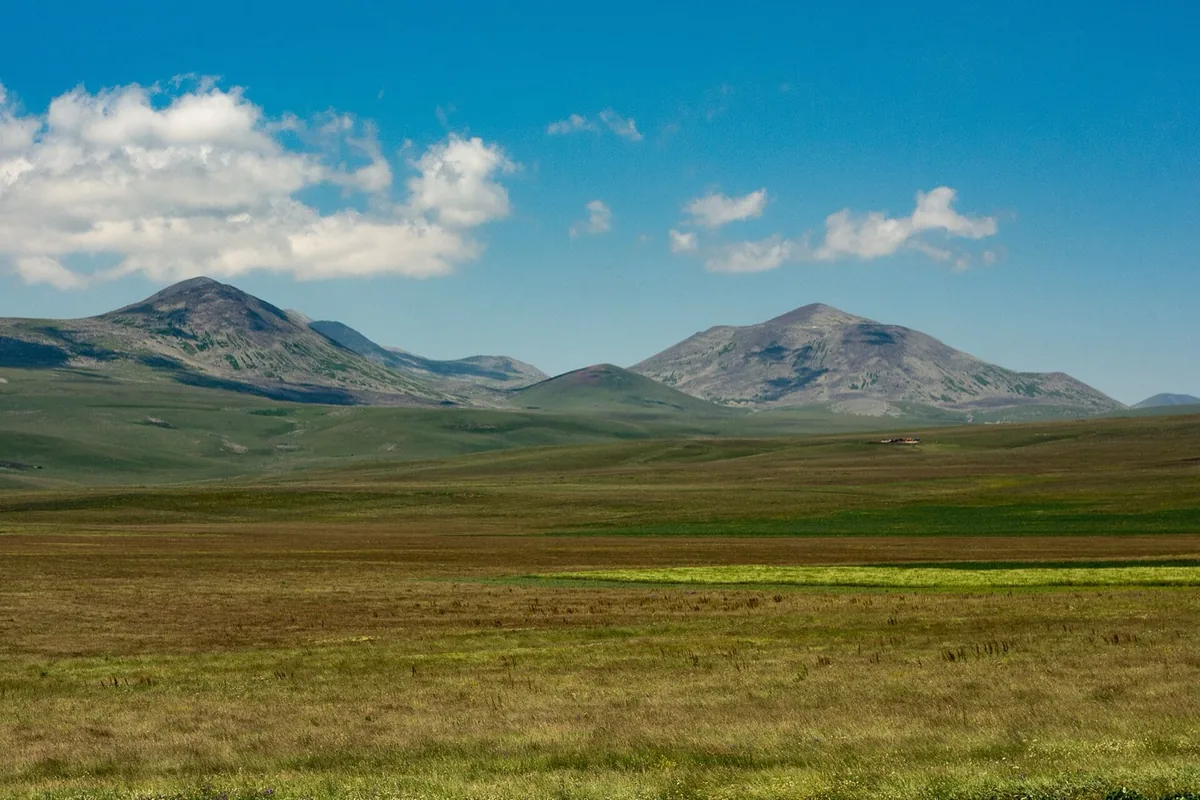
The south-east by the Armenian and Azerbaijani borders; Dmanisi (the earliest hominins), the David Gareja monastery.
Kvemo Kartli is an open, arid plain in the country's south-east, along the borders with Armenia and Azerbaijan; after Tbilisi it is Georgia's second-ranked region by industrial output. Its administrative centre, Rustavi, is Georgia's fourth-largest city, planned in the 1940s around a metallurgical plant.
The region is Georgia's most multiethnic: ethnic Georgians predominate in the north, Azerbaijanis in the south around Marneuli, Dmanisi and Bolnisi, and Armenians and Greeks have historically lived in Tsalka Municipality.
It is also home to the oldest traces of humans outside Africa (Dmanisi, 1.8 million years) and Bolnisi Sioni, Georgia's oldest dated church (478–493), bearing the earliest inscription in Georgian script.
Kvemo Kartli is Georgia's most multiethnic region, and no single «Kartli costume» exists here: the traditions of different communities coexist side by side. The Azerbaijani population of the south preserves its own folk dress (arkhalig, chepken, kelaghayi headscarves), and the Armenian and Greek communities of Tsalka their own.
Ethnic Georgians in the region wore the general Kartli costume, close to that of Tbilisi and lowland eastern Georgia (a chokha with a set belt for men, a katibi dress for women), without pronounced local distinctions.
What to see
- RustaviA Soviet industrial city planned around a metallurgical plant (from the 1940s), Georgia's fourth-largest, an example of Soviet urban planning.
- Asureti (Elisabethtal)A German colony founded in 1818 by Swabians from Württemberg and named Elisabethtal; under Soviet rule it was renamed Asureti. Straight streets, half-timbered houses, a church consecrated in August 1871, and a surviving German cemetery where one slab reads «Auf Wiedersehen!». In the autumn of 1941 the Germans were deported and highlanders from Racha were moved into the emptied houses; their descendants live here still. The church was restored in 2020 and now holds an exhibition of photographs. The Shala grape, also called Asuretuli Shavi, comes from here. The full story is in the essay «Asureti: two communities of one village».
- Bolnisi Sioni CathedralGeorgia's oldest surviving church (478–493), bearing the earliest dated inscription in Georgian script; the Bolnisi cross appears on the national flag.
- Tsughrughasheni ChurchA church of 1212–1222, said by legend to have been built by King George IV Lasha over the grave of his beloved; one of the finest examples of architecture from Tamar's era.
- DmanisiA multi-layered site: beneath the medieval town lie the oldest remains of the genus Homo outside Africa (c. 1.8 million years); today an open-air museum.