The Zdanevich brothers
Kirill and Ilia, who discovered Pirosmani
1892–1969 · 1894–1975
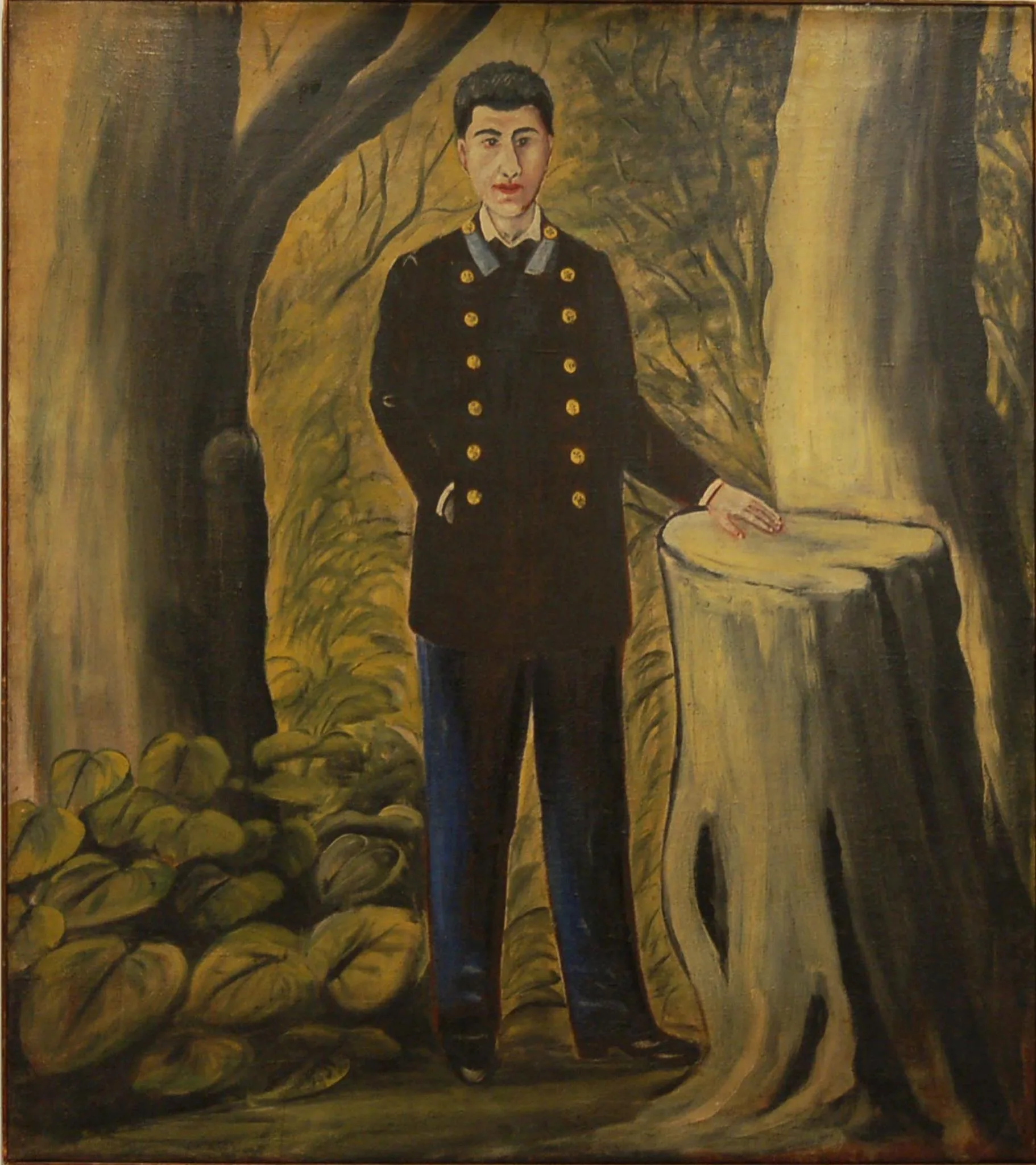
Kirill (1892-1969) and Ilia (1894-1975) Zdanevich grew up in Tiflis, in the family of Mikhail Zdanevich, a Pole who taught French, and Valentina Gamkrelidze, a Georgian pianist who had studied under Tchaikovsky. Kirill studied painting in Tiflis, then entered the Academy of Arts in St Petersburg without finishing the course; Ilia graduated in law from Petrograd University in 1917, wrote manifestos and declared himself the founder of «everythingism». Both kept to the circle of Mikhail Larionov and Natalia Goncharova.
In 1912 Kirill, together with his friend the painter Mikhail Le Dentu, saw in a Tiflis tavern the paintings of an unknown master, and the younger brother turned the find into an event: on the tenth of February 1913 he printed the article «A Self-Taught Artist» in the paper Zakavkazskaya Rech, and on the twenty-fourth of March that year the paintings of Niko Pirosmani hung in Moscow at the futurist exhibition Target. Kirill bought works from the artist and commissioned new ones; that is how his collection came together. The details of the story are told in a separate essay in the archive.
In 1917-1920 Tiflis was for them not a province but a centre. In the autumn of 1917 both brothers, together with Alexei Kruchenykh, Nikolai Chernyavsky, Lado Gudiashvili, Kara-Darvish and Ziga Valishevsky, started the Syndicate of Futurists, and at the beginning of 1918 the company 41° split off from it, named after the latitude on which Tiflis stands. Its core was Ilia, Kruchenykh and Igor Terentyev; they declared zaum the obligatory form of art, gave lectures and held evenings in the artists' cellar called the Fantastic Tavern, and in 1919 brought out the single issue of the newspaper 41° with their manifesto. Ilia wrote plays in zaum, which he called «dra»; Kirill designed the futurists' books and stage productions, and later worked at the Rustaveli theatre. In October 1920 Ilia left and the company fell apart.
Afterwards the brothers parted ways. In 1920 Ilia left through Constantinople for Paris, became Iliazd, befriended Picasso, from 1927 designed textiles for Chanel and published artists' books. In 1972 he brought out Pirosmanashvili 1914, which carried a translation of his own early article; Picasso made the portrait of Pirosmani for it as an etching and signed the book in December, four months before his own death. Kirill stayed: he designed productions at the Rustaveli theatre, was arrested on the thirtieth of July 1949, given fifteen years and sent to Vorkuta, was released on the twenty-fifth of February 1957 and rehabilitated, and in 1963 published a book on Pirosmanashvili. Ilia died in Paris, Kirill in Tbilisi; a street in the Georgian capital carries their name.