Elguja Amashukeli
The sculptor whose figures Tbilisi knows itself by
1928–2002
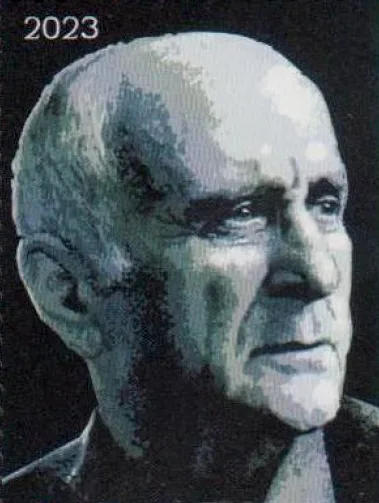
Elguja Amashukeli (1928-2002) was born in Tbilisi and worked in that city all his life. In 1946 he entered the sculpture faculty of the Tbilisi Academy of Arts, studied under Nikoloz Kandelaki, one of the founders of the Georgian school of sculpture, graduated in 1955 and stayed on as a postgraduate, taking as his subject a design for a monument to Vakhtang Gorgasali. In 1958, when the competition for a monument to the city's founder was announced, the first prize went to him.
That same 1958 was the fifteen hundredth anniversary of Tbilisi, and his Mother of Kartli rose on the Sololaki ridge: a woman with a cup of wine in one hand and a sword in the other, first in wood, and from 1963 in aluminium. The sculptor was thirty. In the same years came the reliefs at the entrances to the city and the bas-relief for the jubilee, and in 1965 the relief at the portal of the Rustaveli metro station. The equestrian Vakhtang Gorgasali above the Kura by Metekhi, begun in 1959, was set up in 1967 with the architects T. Kandelaki and D. Morbedadze. Then came Rapiel Eristavi (1974), Pirosmani kneeling with a lamb in his hands (1975), Deda Ena, the Bell of Knowledge, a monument to the first school primer (1983), The Tiger and the Brave Young Man after the folk poem (1985), and Pharnavaz I (2000). Outside the capital: the memorial at Poti, the Victory memorial at Gori (1979), Ilia Chavchavadze in Batumi (1987), David the Builder in Kutaisi (1995).
The art historian Ketevan Kintsurashvili writes that the unveiling of each of his monuments was a public celebration, after which the work was argued over for a while until it settled into its place and became a natural part of it. Amashukeli received the Rustaveli State Prize for the Mother of Kartli, the Gogebashvili prize for Deda Ena in 1984 and the USSR State Prize in 1986 for the memorial at Gori; he was People's Artist of Georgia from 1978 and of the USSR from 1988, an honorary citizen of Tbilisi from 1981 and chairman of the Georgian Artists' Union from 1981 to 1996. He held that monumentality is an innate sixth sense, and gave that title to his book of 1987; he also wrote Letters on Art and Time the Creator. He was married to the poet Lia Sturua. He died on the sixteenth of March 2002 and is buried in the Didube Pantheon.