Kotias Klde — Caucasus Hunter-Gatherers (aDNA)
Ancient DNA from Kotias Klde cave defined the “Caucasus Hunter-Gatherers” (CHG), a distinct ancestral population that contributed to the gene pool of Europe and South Asia.
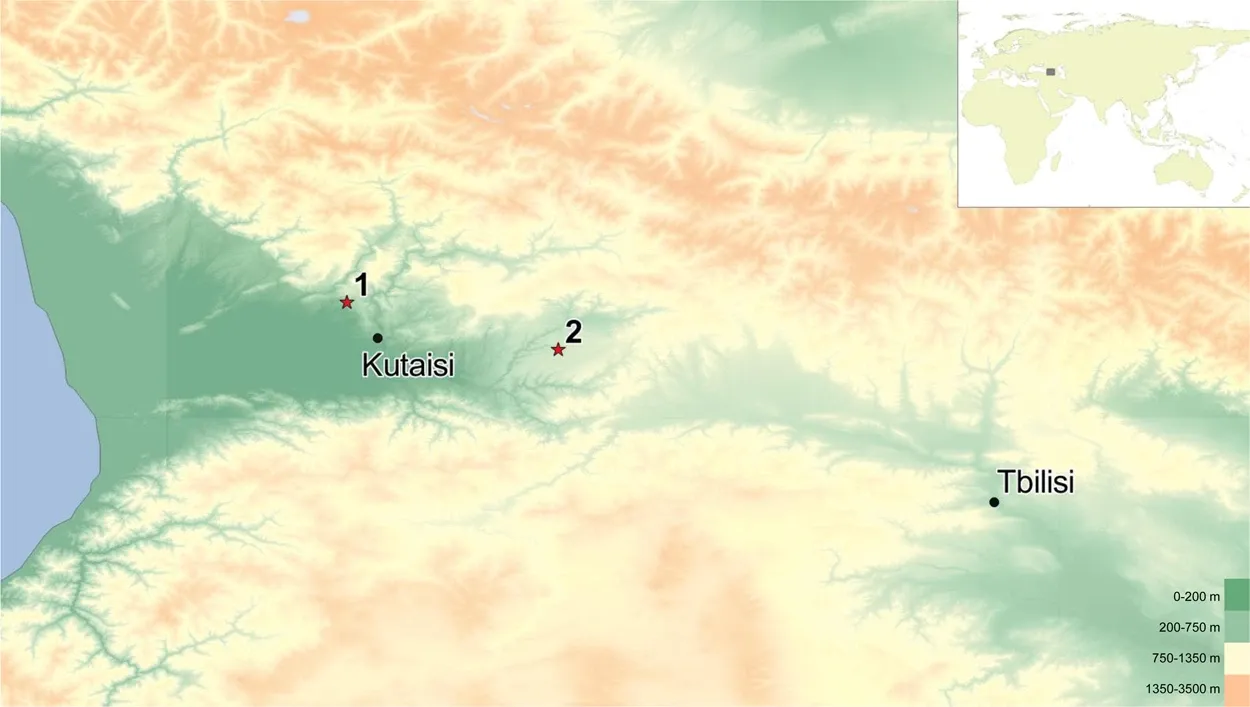
Kotias Klde is a rock-shelter (cave) in western Georgia, in Imereti. From the bones of a person who lived in the Mesolithic (about 9,700 years ago), researchers extracted and read ancient DNA; the results were published in 2015 by a team led by Eppie R. Jones (senior authors Ron Pinhasi and Daniel G. Bradley; Nature Communications). The Kotias Klde and Satsurblia caves themselves were excavated by the Georgian archaeologists Tengiz Meshveliani and Nino Jakeli.
The analysis showed that this individual, and a genome from the nearby Satsurblia cave, belong to a distinct ancestral lineage — the «Caucasus Hunter-Gatherers» (CHG). It had split from Western Hunter-Gatherers around 45,000 years ago and long remained isolated during the Last Glacial Maximum.
Later the CHG made a major contribution to the gene pool of the steppe herders (the Yamnaya culture) and, through them, to the population of modern Europe; the same lineage is traced in the Near East and South Asia.
The caves of western Georgia thus proved to be a key to one of the principal ancestral components of Eurasian humanity — a discovery at the meeting point of archaeology, genetics and the history of the continent's peopling.