Asureti: two communities of one village
The German colony of Elisabethtal, the deportation of 1941 and the Racha families who moved into the emptied houses.
1818
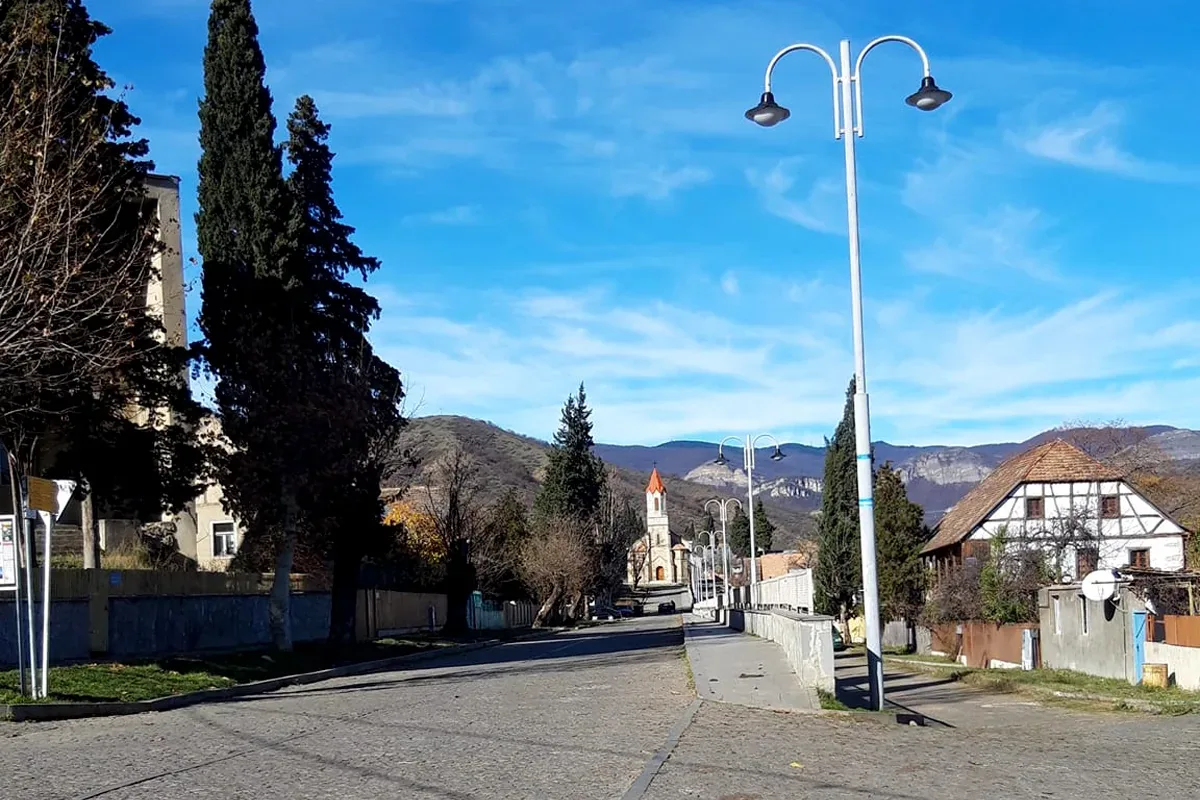
Asureti lies in the Tetritskaro municipality of Kvemo Kartli, an hour's drive from Tbilisi. Local accounts say a Georgian village, Samachveti, stood here before and was emptied by the raids of the seventeenth and eighteenth centuries. In 1818 Swabian Protestants from Württemberg came to the spot, one of some twenty German colonies founded in Georgia at the time, and named their settlement Elisabethtal after the Empress Elizabeth Alexeievna, wife of Alexander I. Under Soviet rule the name was changed to Asureti.
The colonists built the village their own way: straight streets, half-timbered and stone houses, orchards and vineyards, large cellars, dairy farming and crafts. The church was consecrated in August 1871, and the date can still be read above the entrance.
Around 1830 a colonist named Schall found a wild vine in the woods nearby and brought it into cultivation. The variety was named after him: Shala, in German Schalltraube, also known as Asuretuli Shavi, «the black of Asureti». Today Asuretuli Shala is a protected designation of origin, while the German winery of 1931 stands in ruins.
In June 1941 the war with Germany began and Soviet Germans were declared unreliable without exception. That autumn the German population of Georgia, more than twenty thousand people, was deported to Kazakhstan, Siberia and Central Asia; many of the men were already in labour camps. Most were never allowed to return.
A village with its houses, cellars, orchards and livestock could not be left standing empty, so highlanders were moved in, above all peasants from Racha, where arable land was scarce. The Racha families thus entered German houses that were almost untouched, and the plan of the colony survived. Some came from Skhvava: Davlianidze and Enukidze families still live in Asureti, whose forebears came down from there.
Under Stalin the church lost its steep roof and was turned into a club with a cinema hall; the club ended in a fire. In 2020 the building was restored and now holds an exhibition of photographs. The German cemetery survives, and one of the slabs reads «Auf Wiedersehen!». The streets and the half-timbering stand, only the owners have added carved balconies in the Tbilisi manner. Most of today's residents of Asureti are descendants of those Racha families: they keep the memory both of their mountain home and of the colony whose houses they entered.