Giorgi Mazniashvili
General of the First Republic, the march on Sochi
1871–1937
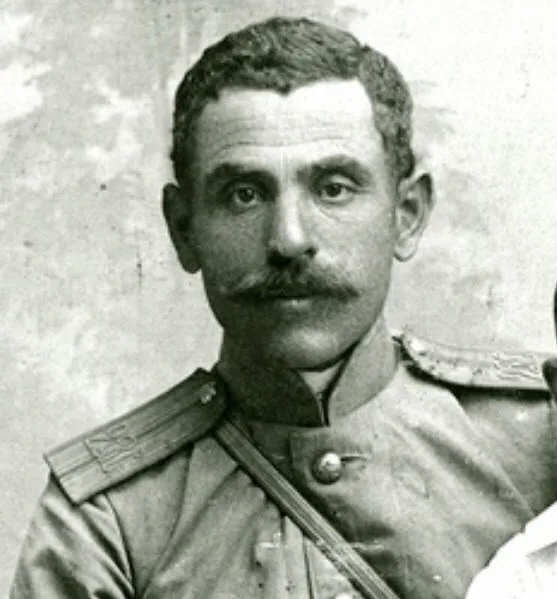
Giorgi Mazniashvili (1871-1937) was born in the village of Sasireti near Tbilisi, rose to colonel in the Russian army, was wounded in the Russo-Japanese war and received the Cross of St George. In 1918 he became one of the chief soldiers of the Democratic Republic of Georgia: in April his units stopped the Turkish advance at the river Choloki in Guria.
That summer came the march north along the Black Sea. In June Mazniashvili was made governor general of Abkhazia and put down a pro-Bolshevik revolt there, then took Gagra, and in July his troops entered Adler and Sochi and, by the end of the month, Tuapse. He was ordered to control the Tuapse to Maikop railway and to act together with the Kuban government and Denikin's Volunteer Army: in Tbilisi the Whites were seen as allies against the Bolsheviks. In the autumn the Sochi district was joined to Georgia, but the alliance fell apart, because Denikin demanded a single Russia with the Caucasus inside it. In February 1919 the Volunteers attacked and pushed the Georgian units back to the Bzyb.
Then came service as governor of Tbilisi, command in the Georgian-Armenian war, and in February 1921 the defence of the capital: his detachments held off the Red Army on the Soghanlughi heights. In September 1921 Mazniashvili was arrested as a counter-revolutionary; the death sentence was commuted to exile in Persia. He returned to his home village and in 1937 was shot without trial.